AI Data Center Networking Test
AI clusters are only as strong as their weakest link. VIAVI helps you validate interconnects, optics, fabrics, AI workloads, and security systems that keep AI training and inference running at scale.

Every GPU in an AI cluster depends on the infrastructure around it. A congested path, marginal optic, protocol error, or poorly balanced fabric can delay training, slow inference, and leave costly compute resources underutilized. As teams deploy 800G, 1.6T, Ultra Ethernet, and multi-vendor components, finding the true source of a performance problem becomes increasingly difficult.
VIAVI brings validation together across the AI infrastructure lifecycle, scale-up within the rack, scale out between racks in a fabric, and scale across with coherent links between sites. With protocol analysis, optics and interconnect qualification, realistic AI workload emulation, inference and security testing, and automated manufacturing test, teams can isolate problems faster, qualify new technology with confidence, and move from design to deployment with less risk.
Proven at Every Scale: Scale Up, Scale Out, Scale Across
AI infrastructure scales in three dimensions: within the rack, across racks in the data center, and between sites. Each tier introduces new performance, interoperability, and operational challenges. VIAVI helps teams validate every layer of the infrastructure before it reaches production.

AI Scale Today
AI infrastructure is growing faster than traditional validation methods were designed to support. As networks scale to 1.6T and beyond, GPU clusters expand, and AI services move into production, infrastructure teams need confidence that performance, interoperability, and security issues have been addressed before deployment:
- Capital Efficiency: Identify infrastructure issues before deployment and avoid costly re-spins and field failures.
- Time-to-Revenue: Accelerate optics qualification, infrastructure validation, and cluster deployment so AI services reach production faster.
- Risk Reduction at Scale: Validate interoperability, resiliency, security, and manufacturing consistency before systems scale into production.
- Tokenonmics: Benchmarks time-to-first-token, throughput, and inference performance to better understand the real cost of running AI workloads at scale.
Common AI Infrastructure Challenges
-
Validating AI infrastructure Before It Goes Live
Ensure AI networks can support production-scale workloads while protecting inference endpoints from performance degradation and emerging threats. TestCenter validates AI fabrics under realistic traffic conditions, while Cyberflood extends validation into AI inference performance and security.
-
Bring Lab Validation Into Manufacturing
Quality optics, interconnects, and components before deployment, then carry the same pass/fail criteria into production. ONE LabPro and MAP-300 help teams accelerate readiness while maintaining consistency at scale.
-
Isolate Issues Before They Reach The Fabric
Validate PCIe, CXL, and other high-speed interfaces where GPUs, accelerators, and hosts connect. Xgig provides protocol visibility and root-cause analysis early in the development cycle, helping teams reduce downstream issues and improve manufacturing quality.
remove
-
High-speed fabric validation
TestCenter emulates advanced RoCEv2 and CCL traffic, GPUs, NICs, and Servers from 400G to 1.6T
-
Lifecycle & Regression Support
128 GPU/NIC emulation per port. Native CCL and LLM training traffic at production scale
-
Validating AI infrastructure Before It Goes Live
Ensure AI networks can support production-scale workloads while protecting inference endpoints from performance degradation and emerging threats. TestCenter validates AI fabrics under realistic traffic conditions, while Cyberflood extends validation into AI inference performance and security.
-
Bring Lab Validation Into Manufacturing
Quality optics, interconnects, and components before deployment, then carry the same pass/fail criteria into production. ONE LabPro and MAP-300 help teams accelerate readiness while maintaining consistency at scale.
-
Isolate Issues Before They Reach The Fabric
Validate PCIe, CXL, and other high-speed interfaces where GPUs, accelerators, and hosts connect. Xgig provides protocol visibility and root-cause analysis early in the development cycle, helping teams reduce downstream issues and improve manufacturing quality.
VIAVI Validation Solutions
Validating AI infrastructure often requires multiple tools spanning protocol analysis, optics qualification, fabric testing, AI workload validation, security testing, and manufacturing. VIAVI brings these workflows together with a portfolio designed to support every stage of the AI infrastructure lifecycle, from the first GPU rack to large-scale AI deployments spanning data centers and sites.
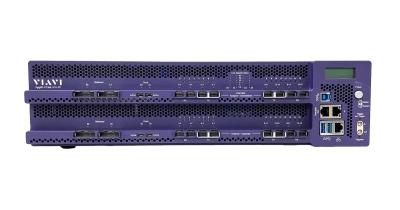
Xgig, PCIe / CXL / NVMe Protocol Analysis
Scale Up | Pre-Silicone, Compliance & Protocol Validation
Xgig captures and analyzes PCIe and CXL traffic during link training, equalization, and error recovery, helping teams isolate protocol and signal-integrity issues before they impact AI infrastructure performance.
Benefits:
- Accurate Root-Cause Isolation
- Fewer Field Escapes
- Proven Error-Recovery Behavior


ONE LabPro, Physical-Layer & Optics Validation
Scale Up / Scale Out / Scale Across | L0-L2
ONE LabPro validates optical components and interconnects from 800G and 1.6T pluggables to coherent DCI optics, helping teams qualify new technologies faster and reduce deployment risk before systems reach production.
Benefits:
- Faster Optics Qualification
- Fewer Costly Field Failures
- Faster Optics Qualification
- One Methodology from 800G to 1.6T


TestCenter, High-Speed Ethernet & AI Fabric Testing
Scale Out | L2-L3 - AI Fabric Validation
TestCenter emulates realistic AI workloads across high-speed Ethernet fabrics, enabling teams to validate performance, interoperability, and congestion behavior before AI infrastructure is deployed at scale.
Benefits:
- Fewer Fabric Bottlenecks
- De-Risked 1.6T Migration
- Proven Ultra Ethernet Interoperability

CyberFlood, AI Inference & Security Testing
Performance & Security | L4-L7 | AI Inference & Security Validation
CyberFlood validates AI inference performance and security by measuring latency, throughput, and time-to-first-token under realistic traffic and attack conditions. Teams can evaluate AI services, DPUs, and SmartNICs before deployment.
Benefits:
- Fewer Latency & Throughput Surprises
- Validated DPU/SmartNIC Offload
- Reduced LLM Abuse Exposure

MAP-300, Optical Manufacturing Test Automation
Manufacturing Validation
MAP-300 automates optical test workflows and brings lab-qualified criteria into high-volume manufacturing, helping teams maintain quality and throughput as AI infrastructure deployments scale.
Benefits:
- Higher Manufacturing Throughput
- Standardized Pass/Fail Criteria
- From Lab Validation to Production
Documentos técnicos y bibliografía
- AI/ML Data Center Network Validation
- Bracing for Impact: How AI Will Transform Digital Industries
- The Future of High-Speed Ethernet across Data Center, Telecom, and Enterprise Networking
- Ultra Ethernet Stack - Open Networking for the Hyperscale and AI Era
- Validating High-Speed Ethernet for Next-Generation AI Networking
Estudios de casos
Folletos
Hojas de especificaciones
Pósteres
Déjenos ayudarle
Estamos a su disposición para ayudarle a avanzar.