Network Digital Twin
For 5G and 6G

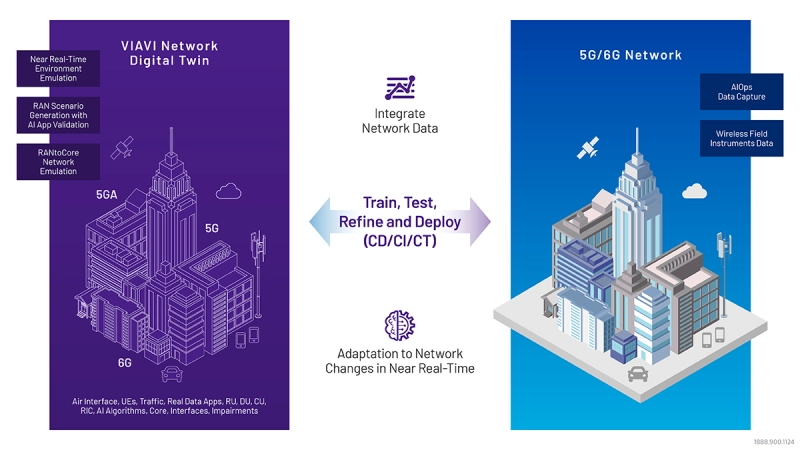
The VIAVI Network Digital Twin enables you to create tailored digital replicas of your network. By leveraging AI and real-world field data from our instruments and software for high realism, you can simulate the RAN environment, devices, and scenarios, facilitating effective training, testing, and refinement of your network—RANtoCore—without disrupting live operations.
Choose from individual components to complete digital twin solutions that are fully adaptable to your requirements and cover the entire protocol stack.
VIAVI Network Digital Twin Solution
VIAVI’s ray tracing technology models detailed micro scenarios, like beam bouncing within buildings. The RANtoCore Network and Cloud Edge emulation solution emulates thousands of mobile devices.
RAN Scenario Generation (RSG) with AI App validation acts as a system-wide RAN Digital Twin, optimizing the entire network.
Ray Tracing excels at fine-tuning individual or small clusters of nodes, while AI RSG is ideal for a broader view. With operator data, RSG and Ray Tracing together deliver the most realistic and powerful RAN Digital Twin available.
Tailor variants to suit different network types or segments, including UE digital twin, RAN digital twin, NTN digital twins, and more.
VIAVI TM500: Emulates thousands of mobile devices on 4G/4.5G and 5G/Open RAN.
TeraVM AI RSG: simulates system-level RAN behavior, creating a RAN Digital Twin that mirrors real network conditions. Key features include:
- Accurate Simulation: Emulates various topologies, configurations, mobility patterns, and traffic profiles on real and synthetic maps.
- Multi-Network Support: Supports 4G, 5G, emerging 6G, and Non-Terrestrial Networks (NTN).
- AI-Driven Optimization: Enhances technologies like massive MIMO for advanced network performance.
VIAVI Ray Tracing: AI-empowered near real-time ray tracing Channel Generator and Network 3D Planning Tool with real-world maps and high-fidelity radio propagation channel, perfect for scenarios like mMIMO optimization and indoor modeling.
VIAVI Automation Management and Orchestration System (VAMOS): automates test campaigns, cases, and executions in a single cloud-based platform.
Beyond our wireless products, VIAVI offers a cloud-native AI for Network Operations (AIOps) platform that collects and aggregates extensive data, applying intelligent AI to separate signals from noise, rapidly identify root causes, and automatically resolve issues. This live network traffic capture solution complements the network digital twin, making it the most realistic solution on the market.
Develop and test cognitive, AI-driven Self-Organizing Networks (SON) and RAN applications in real-world scenarios.
Partner with VIAVI
- End-to-End Network Emulation: From RANtoCore, leveraging lab-to-field and field-to-lab insights to drive proven results for NEMs and CSPs throughout the R&D lifecycle.
- Best Emulator Portfolio: REST API for scheduling, deployment, configuration, execution, and result collection— with the best UE emulation solution in the market.
- Rapid Synchronization: swift alignment between physical and digital twin networks.
- AI-Driven RAN Scenario Generation: Premium datasets to fuel AI training.
- Comprehensive Protocol Capabilities: Support for the full stack of protocols.
- Real-Time Ray Tracing: Optimize EM/RF propagation
- Full Automation and Orchestration: With VIAVI Automation Management and Orchestration System (VAMOS).
- Smart Training Models: Embedded intelligent training frameworks.
- Environment Agnostic Deployment: Flexibility across various deployment environments.
- AI-Enhanced Efficiency: Better computing efficiency through AI integration.
- Extensive 3GPP and O-RAN Support: Rich support for critical features.
- Smooth Transition to 6G: VIAVI Marconi Labs’ expertise in Ray Tracing and 6G digital twin, digital twin technology, network digital twin, and digital twin network leadership for a seamless shift from 5G to 6G
-
Network Digital Twin
Intelligent Twin Technology for efficient, reliable, secure 5G and 6G networks
-
 Tried & Tested: Expert Talks Podcast
Digital Twin Technology Defined
Digital twins are virtual representations of physical objects or systems that use real-time data and advanced modeling technology to accurately simulate the behavior of their real-world counterparts. The high levels of accuracy, detail, and synchronization found in digital twins allow the impact of various changes and scenarios to be tested in the digital realm. Industries and professions that have embraced the benefits of digital twin technology include:
- Aircraft designers testing the feasibility and safety of new concepts virtually.
- Manufacturing operations using digital twins to optimize process efficiency and predict bottlenecks.
- Healthcare providers and researchers predict disease progression using precise digital models of patient organs and anatomy.
- Smart cities utilize digital counterparts to optimize energy consumption and traffic flows.
A digital twin network is a virtual replica of the hardware and software comprising a physical network, including RAN, core, and user mobile device elements. Data streams from the operating network are continuously incorporated to mirror the latest network conditions. An infinite number of configurations, mobility patterns, and traffic profiles can be emulated in the twin to provide unprecedented prototyping, testing, and self-optimizing capabilities.
The Benefits of Digital Twin Networks
In all their diverse applications, digital twins provide a platform to assess new concepts in a safe and cost-effective manner. Data collected from physical networks also turns digital twins into the ultimate monitoring tools, making the impact of any changes instantly accessible. Additional benefits of digital twin networks include:
- On demand testing: New use cases and scenarios can be introduced to the network digital twin to test their impact without risking service degradation or interrupting ongoing operations.
- Resource management: Spectrum utilization and energy consumption must be continuously optimized to fulfill the promise of 5G as a sustainable topology. Modeling and analyzing network usage and traffic loads in the digital twin supports intelligent resource allocation.
- Security threat emulation: Complex multi-vector cyberattacks launched in the digital twin network help to identify vulnerabilities and mitigate risks proactively without exposing the live network to either real or synthetic threats.
- Massive MIMO optimization: Digital twins can simulate antenna misalignments and RF distortions to optimize MIMO calibration and ongoing performance. Feedback from live MIMO arrays is used by the digital twin to continually adapt antenna phase shifts and sleep cycles.
The Greatest Challenges in Building Digital Twin Networks
Digital twins emulating the behavior of objects like airplanes, buildings, or engines must continually transfer information between the physical and digital realms to maintain an accurate representation. This challenge is multiplied many times over for highly complex and unpredictable 5G and 6G networks, making them highly ambitious use cases for digital twin technology. The obvious performance, efficiency, and security benefits are gated by challenges that include:
- Data integrity: The high volume of data collected from cell towers, user devices, and other network elements can make it difficult to provide the digital twin with a consistently clean and comprehensive stream of data.
- Network slice complexity: Emulating network slices with varying performance requirements, configurations, and deployment topologies is a challenge that reflects the increased complexity of 5G vs 4G RAN.
- AI model accuracy: Highly dynamic networks push the boundaries of the artificial intelligence (AI) used to generate representative traffic, mobility, and RF channel interference scenarios.
- Scalability: Networks continue to grow in both size and complexity, so their digital counterparts must be capable of scaling and evolving quickly to stay in sync with the latest configuration.
- Security risks: The ongoing connection between digital twins and live networks makes them compelling targets for attackers seeking to corrupt network infrastructure, identify weaknesses, or intercept data transmissions.
Network Digital Twin FAQ
A network digital twin moves the complexity of 5G and 6G networks into the digital realm by replicating software-based RAN and core functions while emulating MIMO arrays, RF channels, user traffic, and other variable elements that continually interact with and influence the network. Once established, the digital twin becomes a fully operational testbed, where new network enhancements and features are safely piloted.
Creating a realistic digital twin entails replicating all network elements while maintaining a live data feed from the physical network. Mimicking the latest equipment status, signal strength, and traffic levels enhances the value of the digital twin for both performance optimization and accelerated test processes.
The difference between conventional network modeling and digital twin technology parallels the important differences between simulation and emulation. While the former is used to replicate the infrastructure and behavior of the network in the lab, the latter is continually updated with live data from the actual network to create a dynamic representation that changes as the network evolves and expands. Conventional models, while still valuable, are only capable of providing a snapshot of the network at a specific point in time. This distinction is what makes digital twins so valuable for predictive analysis and optimization purposes.
While the most basic digital twins use a single model to represent a physical object, complex applications like smart cities, factories, and telecommunication networks utilize multiple digital twins working in tandem to emulate the overall system. The essential components and elements that make up advanced network digital twins include:
- AI-driven RAN Scenario Generation (RSG) to emulate the entire RAN
- Ray tracing technology to model specific beam behaviors in detail
- UE emulation solutions to simulate thousands of mobile devices
- NTN digital twins to simulate non-terrestrial network behavior
This modular approach to digital twin technology allows real-world and emulated elements to be mixed and matched at will, to assess performance and compatibility issues efficiently and proactively.
The real-time connection to the physical world that makes digital twins so valuable can also present security risks when endpoints are exploited to infiltrate the network digital twin. Proactive risk assessments, strong encryption protocols for data transferred between physical networks and digital twins, and continuous network monitoring practices help to safeguard the overall security posture.
Once operational, the digital twin plays a vital part in mitigating security risks by providing a platform to test the impact of malware, DDOS attacks, eavesdropping, and other potential threats, and verify the effectiveness of new mitigation strategies. Security teams can leverage this insight to continuously optimize real network security tools and practices.
Artificial intelligence (AI) working in conjunction with digital twins improves network security by generating complex and realistic cyberattack scenarios to test in the digital realm, but this is just one of the many ways AI is intrinsically linked to network digital twin performance. AI models trained using real-world data make the generation of hyper-realistic RAN and UE scenarios possible, introducing the same unpredictable bustle of activity found in physical networks.
Machine learning (ML) techniques are used to suggest power consumption, frequency allocation, and beamforming improvements that are piloted in the digital twin as part of a continuous improvement loop. AI integration also provides a boost to computing efficiency to help manage the intense load on dynamic network infrastructure.
Despite the nearly unlimited possibilities availed by the current state of digital twin technology, the years and decades ahead will take us to a much higher performance plateau. As the accuracy of AI and ML-driven emulation improves, digital twins will expand their reach into complex applications like agriculture, energy system management, and global supply chains.
The advent of 6G wireless is still years away, but the next generation of cellular technology will foster more accurate and dynamic digital twins across all industries, featuring near-instantaneous data transmission from an exponentially larger IoT. 6G will also become the first AI-native wireless technology, reducing barriers between the digital and physical realms while making large-scale network digital twins possible.
Brochures
Video
White Papers & Books
Let Us Help
We’re here to help you get ahead.