MU-MIMO Test
Reach peak efficiency for 5G networks

Why MU-MIMO?
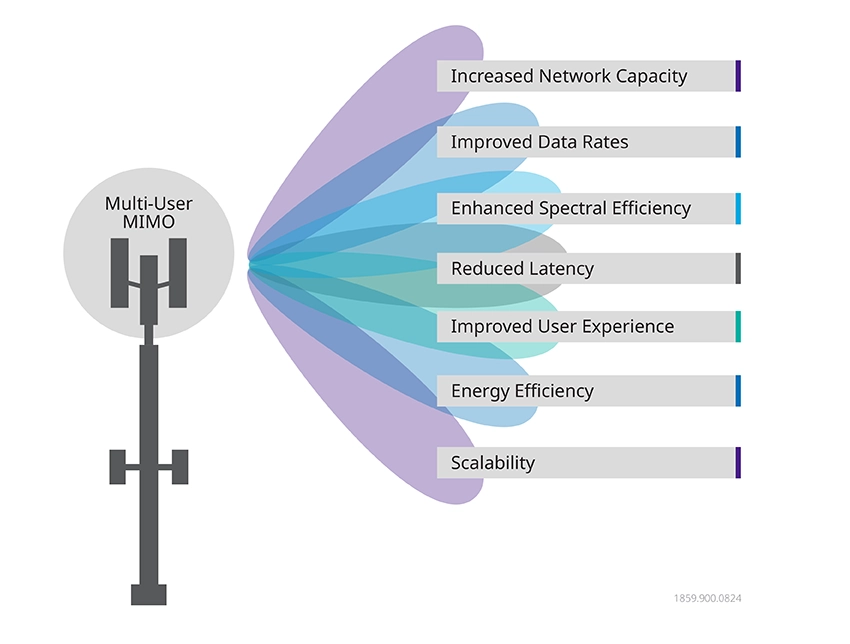
The combination of capacity, bandwidth, and speed required to ensure the promise of 5G makes efficient resource utilization essential. Multi-user MIMO (MU-MIMO) has become a key enabler of this transformation by allowing the same spectrum to be shared among users without sacrificing performance.
Learn more about MU-MIMO benefits and challenges.
MU-MIMO Testing: Making an Impact on QoS
The challenges inherent to MU-MIMO validation, deployment, and operation underscore the balance between high QoS expectations and the growing demand for high-speed, low-latency communications. To provide efficiency improvements through MU-MIMO integration, the base station must have accurate channel information for each discrete user while accounting for interactions between complex gNB scheduling.
Shifting comprehensive MU-MIMO test and validation processes upstream through a combination of emulation, dynamic channel modeling, and OTA testing is the best way to proactively impact QoS while minimizing unnecessary rework and delays.
How VIAVI Delivers MU-MIMO Efficiency
Validation in the lab is the key to realizing the efficiency benefits of MU-MIMO in the field. The industry-leading VIAVI TM500 Network Tester provides an ideal platform for advanced multi-carrier MU-MIMO testing and validation, with dynamic digital channel modeling and fully integrated UE emulation. With digital spatial channels conveniently modelled in the FPGA cards, the VIAVI MU-MIMO Front End is designed to verify throughput and capacity while maintaining an emphasis on flexibility.
MU-MIMO validation: An end-to-end approach
The TM500 is a key to overcoming the challenges preventing efficient 5G spectrum utilization. Modular and economically scalable MU-MIMO validation coupled with easy setup and reliable results puts vastly improved efficiency within reach. These attributes lie at the heart of an end-to-end MU-MIMO test strategy that also encompasses:
- TeraVM: The VIAVI TeraVM RAN Scenario Generator provides hundreds of UEs per beam and sophisticated mobility patterns to ensure MU-MIMO and beamforming performance is vetted through demanding real-world scenarios. Immediate “per UE” visibility delivers real-time metrics and results.
- TM500 O-RU Tester: This purpose-built solution is designed to meet the unique challenges of radio unit and fronthaul testing for disaggregated O-RAN networks. These capabilities are also essential for verifying MU-MIMO performance over a digital O-RAN interface.
O-RU MU-MIMO Testing: Performance and Compliance Simplified
Ensure your equipment meets top performance and compliance standards with VIAVI and Rohde & Schwarz. Our solution covers functional testing, 3GPP and O-RAN conformance, and performance validation, including O-RU onboarding, certification, and badging via OTIC labs.
Key benefits include:
- RF & 3GPP Coverage: Solid RF performance and assured compliance.
- Cost Efficiency: Lower TCO, better ROI, and energy savings.
- Better Productivity: Versatile applications and improved engineering workflows.
- Extensive Testing: Ideal for E2E, 3GPP, O-RAN, and O-RU testing.
- Seamless Integration: Simplified onboarding with O-DU optimization.
- Throughput & Coverage: Reduce interference for optimal SNR.
- Beamforming: Enable precise spatial separation for MU-MIMO devices.
- Interference Control: Align phase and amplitude for peak beam performance.
- Dynamic Resource Use: Optimize power control and UL/DL transitions.
- Latency Management: Synchronize antenna elements effectively.
- 3GPP RF Standards: Ensure sensitivity, interference filtering, and minimal spurious signals.
- O-RAN Compatibility: Enable smooth FH interfacing between O-RU and O-DU vendors.
- Extensive Coverage: 22 WG4 and 19 3GPP TS.38.141-1 test cases.
- Integrated Tools: VIAVI and R&S for full 3GPP test case coverage.
- Versatile Setup: Maximizes reusability for conformance, functional, and E2E testing.
- Cost and Energy Efficiency: Lower TCO with reduced Performance Testing: Compatible with TM500 for enhanced product testing.
-
 Real-world Testing of MU-MIMO O-RAN Equipment
Learn how to optimize MU-MIMO O-RAN performance.
-
 Tried & Tested: Expert Talks Podcast
Use Cases
MU-MIMO E2E RF Test (Cable)
-
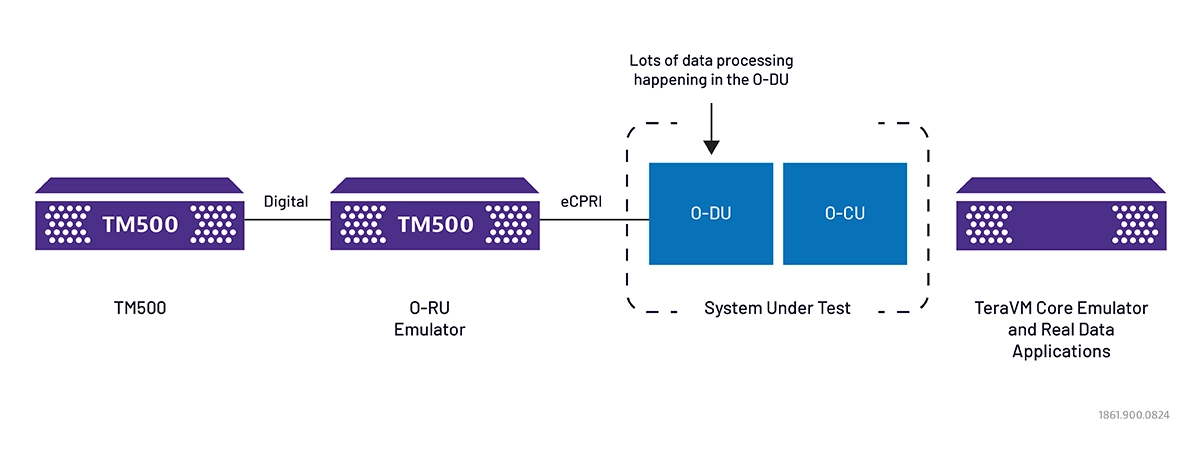
The TM500 Network Tester and TeraVM Core Emulator with Real Data Applications bookend a comprehensive, end-to-end (E2E) test configuration designed to effectively validate the performance and interoperability of connected O-RU, O-DU, and O-CU system elements. Data streams produced through this use case provide inputs for UE emulation that incorporates a wide variety of MU-MIMO scenarios.
MU-MIMO End-to-End Test (O-RAN)
-
The O-DU is responsible for intensive beamforming and MU-MIMO data processing in Open RAN networks. In this use case, the TM500 is digitally connected to a TM500 O-RU Simulator to test the MU-MIMO beamforming performance of the O-DU in a simulated O-RAN fronthaul configuration. Emulation of both the UEs and O-RU allows the O-DU to be validated in isolation before it is integrated with an actual O-RU.
Image
Real OTA Performance Validation of MU-MIMO in Chamber
-
Over-the-air (OTA) testing of the O-RU provides additional insight into Massive MIMO and MU-MIMO system level performance. ETS-Lindgren was selected to deliver an RF-shielded anechoic chamber in support of the VIAVI Automated Lab-as-a-Service for Open RAN (VALOR™). This sealed chamber allows radio manufacturers to perform Massive MIMO OTA testing for up to 16 parallel spatial layers in a controlled environment.
MIMO Interference Mitigation Using AI
-
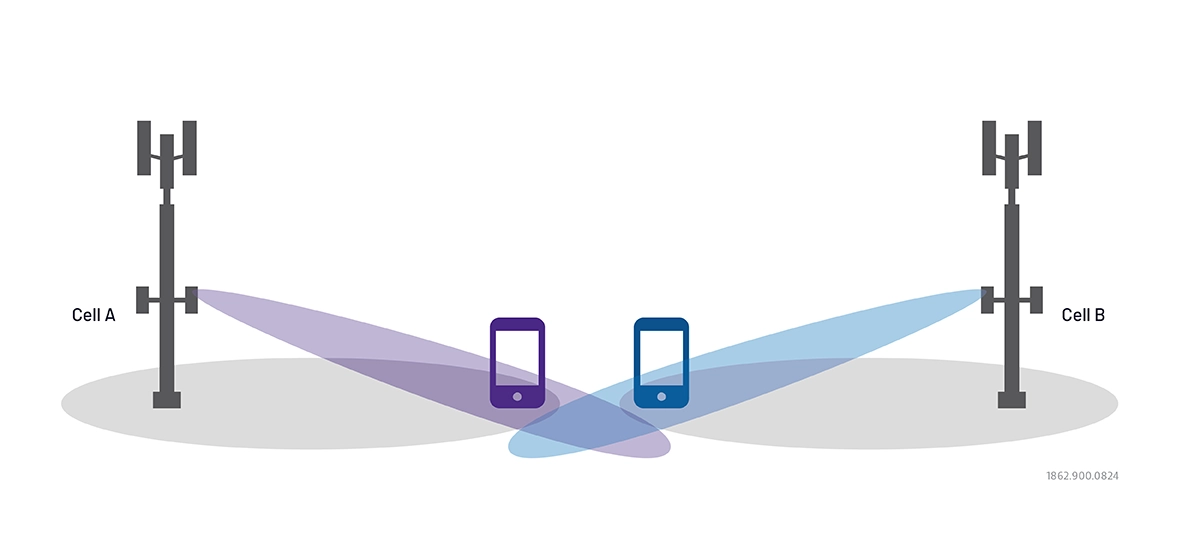
When radio beams from neighboring cells overlap, this can lead to interference that results in reduced throughput for users. AI algorithms can mitigate beam interference by ensuring beams from different cells don’t point in the same direction simultaneously. rApps can be trained to facilitate these controls by continuously analyzing UE SINR and beam weight feedback. TeraVM provides a platform for rApp training and testing that is supported by challenging UE scenario emulation.
Image
MU-MIMO O-RU Test
-
VIAVI and Rohde & Schwarz deliver a complete solution to ensure top performance and compliance standard requirements are met. From functional testing and 3GPP/O-RAN conformance to performance validation, our approach includes O-RU onboarding, certification, and badging through OTIC labs.
The VIAVI Difference for MU-MIMO
VIAVI provides the most advanced and scalable MU-MIMO test and validation options available, with proven solutions adopted by RF cable, O-RAN, and fronthaul vendors throughout the world. With an unmatched collection of requirements from real use cases, the industry leading TM500 has now emerged as a de-facto MU-MIMO test solution as well.
Collaboration and partnerships with key MU-MIMO vendors and stakeholders, along with active participation and contributions to organizations including 3GPP, the O-RAN Alliance, ITU, and Telecom Infra have empowered VIAVI to provide the right solution for your individual test needs in MU-MIMO
While Massive MIMO multiplies the number of antennas in 5G networks exponentially to support beamforming technology and provide service to a higher number of UE’s, MU-MIMO takes network performance and efficiency to the next level by:
- Enabling access points to communicate with users simultaneously rather than sequentially
- Increasing network capacity and boosting overall efficiency
- Optimizing user QoE by ensuring adequate special separation
End users, operators, and carriers benefit from UEs sharing the same block of valuable spectrum as they strive to get the most out of finite spectral resources, especially in city centers, large event venues, and other highly congested, bandwidth-hungry areas. Operating in concert with beamforming technology to transmit data with pinpoint accuracy, MU-MIMO allows more users to get their content delivered quickly and reliably.
Key MU-MIMO Challenges
The technology underpinning MIMO radio has already been adopted for Wi-Fi and LTE applications, just as single-user (SU) MIMO has gradually evolved to service multiple users. Complex 5G networks compound the magnitude of SU-MIMO vs MU-MIMO performance with exponentially higher numbers of antennas and users. This can make 5G MU-MIMO difficult to validate and manage, especially in dynamic environments where the location of users and signal paths are continually changing.
Inter-beam interference caused by incorrect channel estimation or misaligned beams can lead to reduced QoS and QoE for end users while undermining the many benefits of MU-MIMO. 5G networks set a high bar for beamforming accuracy that must be consistently maintained to support effective operation and safeguard the user experience.
Additional challenges for MU-MIMO vendors, carriers, network operators, and end users requiring ongoing focus and innovation include:
- Spatial Separation: MU-MIMO relies on the spatial separation of signals between users to safeguard performance and prevent interference and other reception issues that reduce throughput. A rigorous approach to deployment and testing is needed to optimize service for all users.
- Setup Time: Massive MIMO and MU-MIMO infrastructure require complex setup and test processes to ensure QoE and end-to-end interoperability with other 5G network elements. Setup requirements can delay deployment and monetization if not properly mitigated through advanced emulation and testing processes.
White Papers & Books
Let Us Help
We’re here to help you get ahead.